How Red Light Therapy Works
Red light therapy is an increasingly researched form of photobiomodulation
(Photobiomodulation is the use of specific wavelengths of light to influence biological processes.)
with potential applications in skin care, hair loss, exercise recovery, and wellness.
The science is promising, but red light therapy isn’t magic—and more research is
still needed to determine the ideal treatment parameters for different goals.
The smartest approach is to choose a quality device, understand what you’re
using it for, follow the manufacturer’s directions, and make consistent use part of
a broader healthy routine.
- What Is Red Light Therapy
- How Does Red Light Therapy Work?
- What Is Red Light Therapy Used For?
- How Long Does Red Light Therapy Take to Work?
- What Should You Look For in a Red Light Therapy Device?
- Red Light Therapy for Skin: What You Should Know
- Is Red Light Therapy Safe for Everyone?
- Choosing a Red Light Therapy Device for Skin
- Red Light Therapy for Muscle Recovery and Exercise
- Red Light Therapy for Hair and Scalp
- How to Choose a Red Light Therapy Device for Your Home
What Is Red Light Therapy
If you’ve spent any time researching wellness, skincare, recovery, or at-home
health technology, you’ve probably come across red light therapy.
But what exactly is it? How does it work? And is red light therapy something
worth adding to your daily routine?
Red light therapy, also known as photobiomodulation (PBM) or low-level light
therapy, uses specific wavelengths of red and near-infrared light to deliver light
energy to the body. Unlike ultraviolet light, which can damage skin, red and
near-infrared light are used at non-thermal levels for a variety of wellness and
therapeutic applications.
The technology has been studied for areas including skin appearance, hair loss,
and exercise recovery. While research is encouraging, results can vary
depending on the device, wavelength, dose, treatment schedule, and the
individual using it.
An In-Depth Look at How Red Light Therapy Works
Red light therapy works by exposing an area of the body to specific wavelengths
of light.
The basic idea is relatively simple: light interacts with biological tissue and can
influence cellular processes. This is why photobiomodulation is being
investigated for applications ranging from skin health to muscle recovery.
Red light generally refers to visible wavelengths, while near-infrared light is
invisible to the human eye and can penetrate farther into tissue.
Rather than thinking of red light therapy as a single treatment, it’s more useful to
think of it as a technology with different applications depending on the
wavelength, irradiance, treatment time, and target area.
Red Light vs. Near-Infrared Light
One of the first things you’ll encounter when shopping for a red light therapy
device is wavelength.
Red light is visible. Near-infrared light is not.
Different wavelengths interact with tissue differently, which is why reputable
devices often use more than one wavelength.
The important takeaway isn’t simply that a device has “more light.” The
wavelength and delivered dose matter.
This is also why comparing devices solely by the number of LEDs can be
misleading. Research has found that treatment variables such as energy fluence
and exposure duration can influence outcomes. Penetration by Wavelength
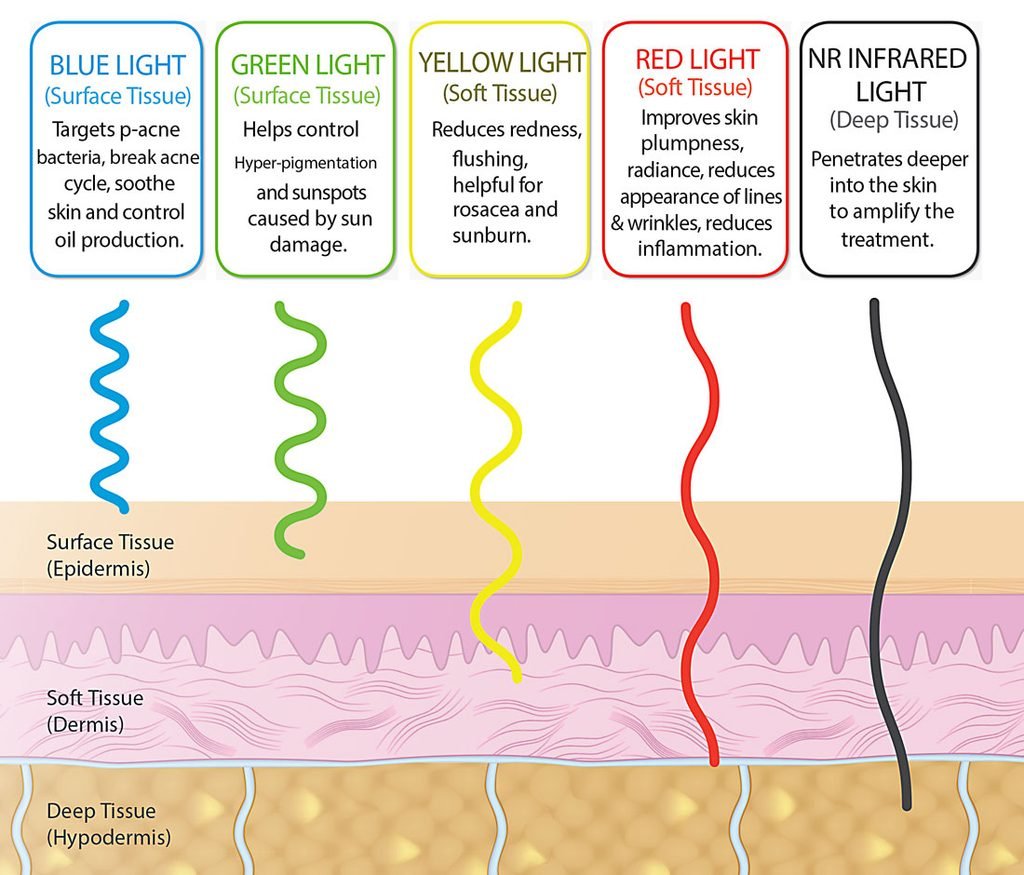
- 630 nm (Visible Red): Reaches about 1 to 2 millimeters deep, targeting the outer layer and upper dermis.
- 660 nm (Visible Red): Reaches about 2 to 3 millimeters deep, entering the full dermis and superficial blood vessels.
- 810 to 850 nm (Near-Infrared): Reaches 3 to 5 centimeters deep, moving past the skin to affect muscles, joints, and bones.
Key Factors That Change Depth:
Power and Area: Larger treatment beams and higher power output help the light travel further before fading
Skin Tone: Melanin absorbs light, meaning red light may penetrate slightly less in darker skin tones.
Blood Flow: Areas with high blood perfusion scatter and absorb more light, reducing overall depth.

What Is Red Light Therapy Used For?
Red light therapy is being studied for a number of applications.
Skin appearance:
Research suggests that red-light devices may help improve aspects of skin
appearance, including fine lines, wrinkles, roughness, redness, and discoloration.
The American Academy of Dermatology notes that some studies have found
subtle to noticeable improvements, although more research is needed to
establish optimal treatment protocols. Exercise and recovery
Photobiomodulation has also been investigated in sports and exercise settings.
A 2025 systematic review and meta-analysis found low-certainty evidence that
photobiomodulation applied before exercise may reduce muscle soreness and
improve muscle performance at 24 hours after exercise-induced muscle damage.
Hair and scalp
Photobiomodulation has also been studied for androgenetic alopecia, commonly
called pattern hair loss.
Several systematic reviews and meta-analyses have reported improvements in
hair density compared with control groups, although protocols and devices vary
considerably.
How Long Does Red Light Therapy Take to Work?
This is one of the most common questions—and one of the most difficult to
answer with a single number.
There isn’t one universal treatment schedule for every device or goal.
Research studies use different wavelengths, doses, devices, distances,
treatment durations, and frequencies. As a result, you shouldn’t assume that a
10-minute treatment with one device is equivalent to a 10-minute treatment with
another.
The best approach is to follow the manufacturer’s instructions for your specific
device.
Consistency is also important. Red light therapy isn’t generally something you
should expect to transform your skin, recovery, or hair overnight.
What Should You Look For in a Red Light Therapy
Device?
When comparing devices, don’t focus on marketing claims alone.
Consider:
● The wavelengths used
● Irradiance and delivered energy
● Treatment area
● Recommended treatment time
● Manufacturer instructions
● Safety features
● Device-specific regulatory clearances where applicable
● Warranty and customer support
● Whether the device is designed for your intended use
It’s also worth remembering that FDA clearance and effectiveness are not the
same thing. The American Academy of Dermatology specifically notes that FDA
clearance indicates a device is considered low risk; it does not establish that
every claim made about a product is effective.
The Bottom Line
Red light therapy is an increasingly researched form of photobiomodulation with
potential applications in skin care, hair loss, exercise recovery, and wellness.
The science is promising, but red light therapy isn’t magic—and more research is
still needed to determine the ideal treatment parameters for different goals.
The smartest approach is to choose a quality device, understand what you’re
using it for, follow the manufacturer’s directions, and make consistent use part of
a broader healthy routine.
Disclaimer: This article is for educational purposes only and is not intended to
diagnose, treat, cure, or prevent any disease or medical condition. Consult a
qualified healthcare professional regarding medical concerns or before beginning
a new therapy.
Red Light Therapy for Skin: What You
Should Know
Skincare has traditionally focused on creams, serums, cleansers, and
professional treatments. But another technology has become increasingly
popular: red light therapy.
Also called photobiomodulation, red light therapy uses specific wavelengths of
red and/or near-infrared light. At-home devices are available in forms such as
masks, panels, and wands.
What Does Red Light Therapy Do for Skin?
Research suggests that red-light devices may improve several visible
characteristics of skin.
Studies have reported potential improvements in:
● Fine lines and wrinkles
● Skin smoothness
● Rough texture
● Redness
● Certain forms of discoloration
● Overall appearance of the skin
The American Academy of Dermatology describes the evidence as encouraging
while also emphasizing that more research is needed to determine the ideal
treatment dose and schedule. Think of it as a consistent skincare technology that may complement the rest of your routine.
How Does It Fit Into a Skincare Routine?
One of the advantages of red light therapy is that it doesn’t have to replace your
existing skincare routine.
For many people, the simplest approach is:
● Cleanse your skin.
● Use your red light therapy device according to its instructions.
● Continue with your normal skincare routine.
Following the instructions for your specific device is important because treatment
parameters vary between products.
You should also pay attention to any eye-protection requirements.
Think of red light therapy and topical skincare as different tools.
A moisturizer helps support the skin barrier. Sunscreen helps protect against UV
exposure. Cleansers remove dirt and excess oil. Serums can deliver specific
topical ingredients.
Red light therapy uses light rather than topical ingredients.
A comprehensive skincare routine can therefore include several complementary
approaches rather than relying on one product or technology.
How Long Does It Take to See Results?
There is no universal timeline.
Clinical studies use different devices and treatment protocols, making it difficult to
translate every study directly into an at-home schedule. The AAD notes that
researchers are still working to determine the safest and most effective amount of
red light for different skin concerns.
Is Red Light Therapy Safe for Everyone?
Red light therapy appears to be safe in the short term for many people, but it isn’t
necessarily appropriate for everyone.
Some medical conditions and medications can increase sensitivity to light.
People with darker skin tones should also be aware that visible light can
contribute to hyperpigmentation in susceptible individuals, according to the AAD. If you have a skin condition, take photosensitizing medication, or aren’t sure whether light therapy is appropriate for you, speak with a dermatologist or other
qualified healthcare professional.
Choosing a Red Light Therapy Device for Skin
If your primary goal is skincare, look for a device designed specifically for facial
or skin use.
Consider:
● Wavelengths
● Treatment area
● Recommended distance
● Treatment duration
● Irradiance
● Ease of use
● Eye-safety instructions
● Regulatory clearance where applicable
● Warranty and support
Be skeptical of products promising dramatic overnight transformations.
Good skincare is usually about consistency rather than hype.
Red Light Therapy for Muscle Recovery
and Exercise
Training hard is only half the equation. If you’re serious about fitness, recovery matters just as much as the workout itself. Sleep, nutrition, hydration, mobility, rest, and appropriate training volume all play important roles. But researchers are also studying another potential recovery
tool: photobiomodulation, commonly known as red light therapy.
What Is Photobiomodulation?
Photobiomodulation uses red and/or near-infrared light to expose tissue to
specific wavelengths of light.
Researchers have investigated whether this approach can influence exercise
performance, muscle fatigue, soreness, and recovery.
The results are promising in some areas, although the evidence isn’t equally
strong for every outcome.
What Does the Research Say?
A 2025 systematic review and meta-analysis examined randomized trials
involving photobiomodulation and muscle recovery.
The researchers found low-certainty evidence that photobiomodulation used
before exercise could reduce muscle soreness and improve muscle performance
24 hours after exercise-induced muscle damage. Red Light Therapy Before or After a Workout?
This is a question without a universal answer.
Some research has investigated photobiomodulation before exercise, while other
protocols examine recovery afterward.
The Bottom Line
The research surrounding photobiomodulation and exercise recovery is
encouraging, but it isn’t definitive.
Some evidence suggests that appropriately administered photobiomodulation
may reduce soreness and support aspects of muscle recovery.
Train smart. Recover properly. Stay consistent.
And let the technology complement—not replace—the basics.
Disclaimer: This article is educational and does not provide medical advice. Red
light therapy is not a substitute for evaluation or treatment by a qualified
healthcare professional.
Red Light Therapy for Hair and Scalp
Hair loss can be frustrating, and anyone who has searched for solutions has
probably encountered countless products promising thicker, fuller-looking hair.
One technology that has received legitimate scientific attention is
photobiomodulation, also called low-level light therapy.
So what does the research actually tell us?
What Is Red Light Therapy for Hair?
Photobiomodulation uses specific wavelengths of light delivered to the scalp.
The technology has been studied particularly in people with androgenetic
alopecia, commonly known as pattern hair loss.
Unlike many hair products that are applied topically, light-based devices are
designed to deliver light directly to the scalp.
Does Red Light Therapy Help Hair Growth?
Research suggests that it can help in some circumstances.
A systematic review and meta-analysis published in 2022 examined 36 studies
involving 966 patients and found that photobiomodulation using red and infrared
light was effective compared with control groups for androgenetic alopecia. Why Does the Type of Hair Loss Matter?
Hair loss isn’t one condition. Pattern hair loss, alopecia areata, telogen effluvium, scarring alopecia, and other causes have different underlying mechanisms.
The strongest body of evidence for photobiomodulation is associated with
androgenetic alopecia. If you’re experiencing sudden, severe, or unexplained hair loss, consider
speaking with a dermatologist before relying on an at-home device.
How Long Does Hair Growth Take?
Hair operates on a biological growth cycle, so expectations are important.
Don’t expect a red light therapy device to produce visible changes in a few days.
Research protocols typically involve repeated treatments over time. A systematic
review examining treatment factors found that exposure duration and energy
fluence were among the variables associated with treatment outcomes.
Choosing a Hair Therapy Device:
If hair and scalp wellness is your primary goal, choose a device specifically
designed and tested for that application.
Look at:
● The wavelengths used
● Treatment protocol
● Coverage of the scalp
● Ease of use
● Manufacturer instructions
● Safety information
● Regulatory clearance where applicable
● Warranty and support
Don’t choose a device simply because it has the highest number of LEDs.
Research suggests that treatment parameters—including energy fluence and
treatment duration—can matter more than simply counting LEDs. The Bottom Line
Red light therapy isn’t a miracle cure for hair loss, but it is one of the
better-studied light-based approaches for pattern hair loss.
Research has found improvements in hair density in controlled studies, while
also highlighting the importance of treatment parameters and realistic
expectations.
How to Choose a Red Light Therapy
Device for Your Home
The red light therapy market has exploded.
Today you can find everything from compact handheld devices to face masks,
targeted panels, and larger systems designed to illuminate significant areas of
the body.
With so many options, choosing the right device can feel overwhelming.
The good news? You don’t need to understand every technical specification to
make a smart decision. Start with your goal.
- Decide What You Want to Use It For
The right device depends heavily on what you want to accomplish.
Are you primarily interested in:
● Skin appearance?
● Facial skincare?
● Muscle recovery?
● General wellness?
● Hair and scalp care?
● Treating a particular area of the body?
Different devices are designed for different applications.
The American Academy of Dermatology recommends choosing a red-light device
created for the concern you’re trying to address.
what to look for when buying red light therapy devices.
1. Light Wavelengths
- Red Light (630–660 nm): Best for surface-level concerns like skin rejuvenation, collagen production, reducing fine lines, and hair growth stimulation.
- Near-Infrared (810–850 nm): Penetrates deeper into the body to target muscle recovery, joint pain, and inflammation.
2. Irradiance (Power Density)
- Measured in mW/cm² (milliwatts per square centimeter), irradiance tells you how much light energy actually reaches your tissue at a given distance.
- Wearable masks: Look for 20 to 50 mW/cm².
- Larger panels: Look for 50 to 100+ mW/cm² depending on how far you stand from the device.
3. Regulatory Safety and Clearance
- Prioritize FDA-cleared or FDA-registered devices, which indicates the product meets established safety and manufacturing standards. You can verify a company’s claims via the official
4. Treatment Area and Form Factor
- Face Masks / Caps: Great for targeted, hands-free facial skin care or hair growth routines because they maintain a consistent distance from the skin.
- Panels / Full-Body Devices: Best if your goal is multi-area treatment, muscle recovery, back pain, or large skin surfaces.
- Targeted Wraps / Wands: Ideal for localized joint or spot pain relief.
5. Build Quality, Heat, and Extras
- Thermal Management: Quality LEDs shouldn’t overheat or create uncomfortable hot spots on your skin.
- Built-in Timers: Automatic shut-offs help prevent overuse.
- Warranty: Look for a solid manufacturer warranty (1 to 3+ years) signalling confidence in the hardware.